Team tracks: the industry with no building
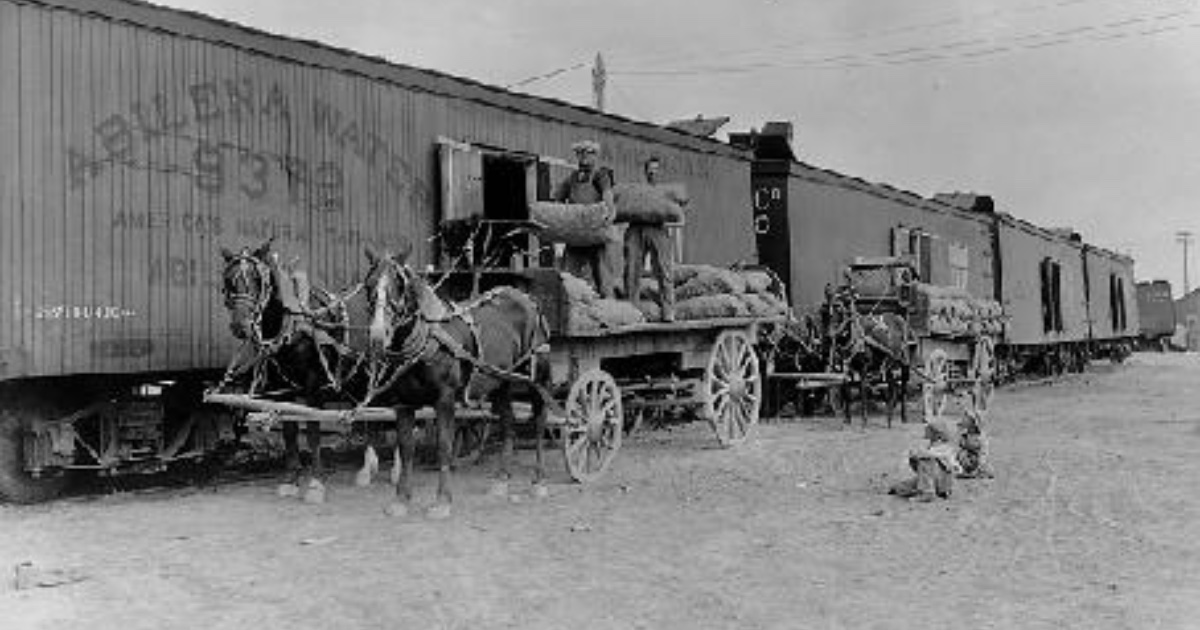
It has no building, it takes any car, and it fits where nothing else will.
The waybill says a boxcar of feed for a farm supply store. You look along the layout. There's no farm supply store. There's no spur with its name on it. There's a short stub track by the depot with a gravel lot beside it and a pickup parked at the end.
That's where the car goes. That stub is a team track, and it may be the most useful industry you can model. It has no building, it takes any car, and it fits where nothing else will.
What a team track is
CSX's railroad dictionary defines it as "a track subject to use by the general public, with facilities for loading and unloading cars." It gives another name too: public delivery track.
The key word is public. The railroad owns the track, not the customer. A shipper big enough to have its own spur has private track. A shipper without one has its car spotted on the team track, they come with a wagon or a truck, and load or unloade it right there, car door to tailgate.
Model Railroader's Ask MR column puts it plainly: it's where the railroad spots cars consigned to a business that doesn't have a spur of its own. The name comes from the teams of horses that pulled those wagons. It's the same root as the word teamster.
Team tracks go back a long way. Wikipedia's entry on sidings notes that early rail service to a town often included a team track on railroad land near the agent, and that in some places their building and operation was regulated by law.
What it looked like
At its simplest, nothing at all. Ask MR describes the basic team track as "a track alongside an empty space." Gravel or dirt, room for a wagon to pull up, and that's it.
Busier ones collected a few tools of the trade:
- A dock at car floor height, so goods could be rolled or carried across instead of lifted.
- A crane for heavy pieces: machinery, stone, pipe.
- An end ramp at the bumper, so wheeled loads could be driven straight onto a flatcar.
- A concrete pad beside the rail, where trucks could stand and forklifts could work.
A working example: the team tracks at Semo Port in Missouri hold up to 24 cars and rent track space by the day or longer. They list a freight house, an end ramp and concrete pads, and the ramp is a converted 63-foot flatcar. That last detail is a good one to steal. A modeler on the Trains.com forum spotted the same trick in a yard at Chattanooga: an old flatcar with one end buried in the ground and the other end at the track.
End ramps need a stub-ended track. You can't drive off the end of a car if there's a turnout there. The U.S. Army's rail transport field manual describes circus-style loading, where vehicles are driven up the ramp and along a string of flatcars, which tells you how long that stub may need to be.
What came and went
Anything a small shipper needed. That's what makes the team track so handy on a layout. One spur can see a boxcar one session, a flatcar the next, and a gondola after that.
Think about who in your town has no spur: the feed store, the lumber dealer on Main Street, the farm implement dealer, the contractor building the new school. Each of them gets cars at the team track. A boxcar of feed sacks. A flatcar of tractors off the end ramp. A gondola of steel for the job site. Even tank cars turn up at some team tracks, unloaded into a tank truck by hose.
Outbound works too. A farmer loading a car of hay or a sawmill too small for its own siding shipping a car of lumber would both use the public track.
They're still out there
Team tracks didn't vanish with the horse. Short lines still advertise them. The Fort Worth and Western offers team track locations for businesses whose shipping doesn't justify their own spur, and the North Shore Railroad in Pennsylvania lists several ground-level team tracks alongside its transload sites.
The line between a team track and a transload facility has blurred. A modern transload usually has an operator, storage and equipment to move bulk from car to truck. A team track can be as simple as it ever was. Some roads have little use for them: the New York and Atlantic on Long Island has team tracks, but most of its customers have their own spurs. So whatever era you model, a team track belongs.
Modeling one
Here's how I'd lay one out on a small switching layout.
- Make it a stub. A dead-end spur off the run-around or the main, ending at a bumper. If you want an end ramp, it has to be a stub.
- Leave one side open. Trucks need to reach the cars. Put the road, the lot or the pad on the side away from the backdrop, or run a street right up to it.
- Size it in cars, not inches. Two or three car spots is plenty. A 40-foot car body is a bit over 5½ inches long in HO and 3 inches in N, before couplers. Measure from the bumper to the clearance point, not to the points of the turnout.
- Name the spots. Dock, ramp, open. Now a waybill can send a car to a spot, and the crew has to think about which car goes in first.
- Let the details tell the story. A truck backed up to a boxcar door. A pallet stack. A tractor halfway down the ramp. Move them between sessions and the same track reads as a different customer.
The ordering problem is where the fun is. If the flatcar for the ramp has to sit at the bumper and the boxcar at the dock, a train that arrives with them in the wrong order has to be sorted before it goes in. On a stub track with three spots, that's a small Inglenook all its own.
Trying it in modelrailsim
You can sketch this in the Layout Designer before you cut any track. Lay the spur, then use the Scenery card for a paved yard and a road beside it; where a road crosses track, the level crossing goes in for you. The Rolling Stock card lists each siding's length to its clearance point and how many 40-foot cars it holds, so you'll know straight away whether your three-spot team track really holds three. Put a flatcar and a couple of boxcars on it at their real lengths and see if they fit.
If you want to work it as a customer, operating sessions build waybills and switch lists for a layout set up for operations, with spotting at the doors as an option. Operating sessions are free for a limited time.
Here's something to try this week. Find the dead space on your layout: the stretch by the depot, the corner past the last turnout, the spot you meant to fill with a building someday. Lay a stub there, two or three cars long, and pave one side. Then write three waybills to it: one boxcar, one flatcar, one gondola, each for a business that isn't on your layout. Run them at your next session and see how much traffic a track with no building can make.
New posts by email
A short email when there's a new post. Nothing else, and you can stop any time.
More from the blog
Building a layout in a spare closet: plans that fit
How to fit a model railroad in a spare closet: measuring reach-in and walk-in closets, switching plans that fit, benchwork tips, and checking it before you cut.
Who gets the throttle next? Running a club layout with a crew
One throttle and four people makes a queue. How club sessions in modelrailsim give each crew member a loco, a job and a switch list, and how to rehearse first.
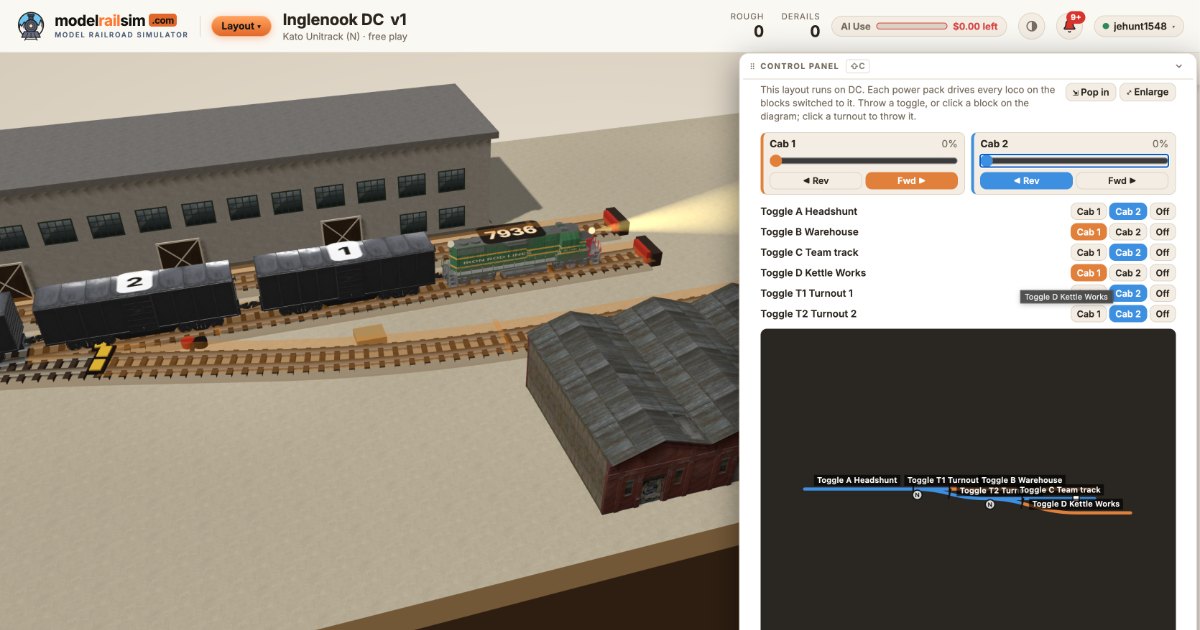
Checking a DC layout's polarity, feeders and blocks before you build
Reverse loops, missing feeders and dead blocks are where DC layouts fail. See how the Layout Designer checks polarity, feeders and blocks before you lay track.